
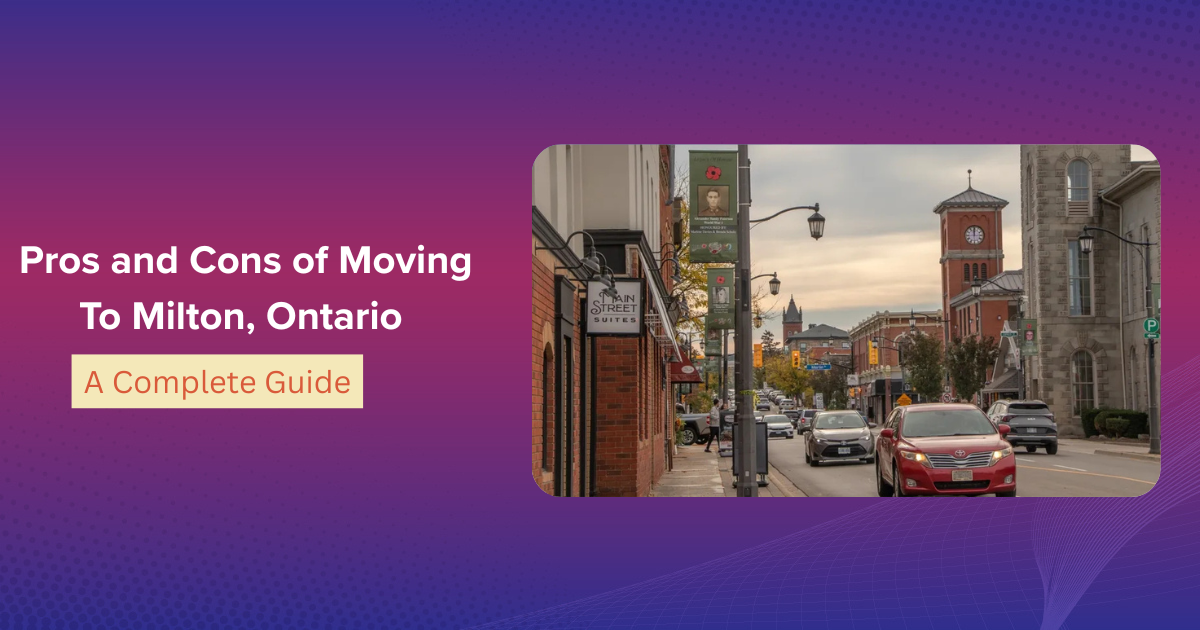
For people considering suburban life near the Greater Toronto Area, the town of Milton, Ontario, is increasingly on many people’s radar.
This gorgeous location is situated in the Halton Region and is part of the thriving GTA corridor.
With attractive housing, a growing economy, and proximity to Toronto, it offers compelling reasons to consider living here while also presenting a few trade-offs.
In this guide, we’ll walk you through the top 5 advantages and disadvantages of living in Milton, Ontario, so you can evaluate whether Milton fits your lifestyle and goals.
5 Interesting Facts About Milton, Ontario
Milton might look like many other suburban towns, but it has a few unique features that give it character and history.
Here are some lesser-known facts about this place:
1. Milton Has a Velodrome
Milton is home to the Mattany National Cycling Centre, an indoor velodrome that hosted cycling events during the 2015 Pan American Games. It is the only velodrome of its kind in Canada, and only the second in North America that meets top international standards.
This serves as a recreation facility and venue for provincial, national, and international events, showing the town’s investment in sport infrastructure and its international exposure.
2. Milton’s Town Hall Was Once a Jail
Milton’s Town Hall has a surprising past. Before it became the town’s main civic building, the site was home to the local courthouse and jail.
The original courthouse was completed in 1855, and a small jail and outdoor yard were added in 1877. For decades, this corner of Milton handled local law and order.
Then, in 1982, the Town of Milton bought the historic property from Halton Region for just $1. After major restoration work, it officially reopened as Milton Town Hall in 1985.
3. Milton Has a Real, Working Blacksmith Shop
Milton is home to one of the rare blacksmith shops in Ontario that still stands in its original location, the Waldie Blacksmith Shop in downtown Milton.
James Waldie Sr., a skilled blacksmith from Scotland, settled in Milton in 1865. He opened his shop on 16 James Street. At its busiest period in the 1890s, the shop employed woodworkers, painters, trimmers, and several blacksmiths.
Unlike many historic shops that were moved to museums, this one was preserved exactly where it stood, thanks to the Milton Historical Society.
4. Milton Is the Birthplace of the Robertson Screw
Every Canadian knows the Robertson screw, the one with the square drive head. But many don’t realise it was invented right here in Milton.
P.L. Robertson, the inventor, got the idea after injuring his hand while using a standard screwdriver in Montréal. Determined to create a safer and better design, he came up with the Robertson screw and patented it at just 30 years old.
In 1908, he relocated his company to Milton and constructed his factory on Bronte Street, where it remains today.
5. Milton’s Water Tower Supports 16,700+ Homes and Businesses
If you’ve driven along Steeles Ave. E. near Esquesing Line, you’ve likely noticed Milton’s tall water tower, but it’s more than just a landmark.
The construction began in 2000, and the tower now supplies clean drinking water and water pressure to roughly 16,700+ homes and businesses in the area.
It can hold up to 6.8 million litres of water, though it typically operates at about 85-90% capacity. Its height helps push water through pipes across the town, making sure taps, showers, and fire hydrants have the pressure they need.
Advantages and Disadvantages of Moving to Milton, Ontario
Before choosing Milton as your new home, it’s important to understand both the benefits and challenges of living here.
Here’s a quick overview to help you decide if Milton is a good fit for your needs and expectations.
| Advantages | Disadvantages |
|---|---|
| Good Housing Market | Higher Cost of Living |
| Low Crime Rate | Longer Commutes |
| Great Employment Market | Fewer Local Amenities |
| Top Notch Schools | Health Concerns from Air Quality and Distance to Major Hospitals |
| Proximity to Toronto | Limited Nightlife |
Advantages of Moving to Milton, Ontario
Milton has many advantages, but here are the top pros to consider if you want to call Milton your home.
1. Good Housing Market
Milton offers a variety of high-quality housing options, making it a strong choice for families, couples, and professionals.
The average sale price for homes in Milton is approximately $1.0 million as of November 2025. That means if you’re planning to buy, be prepared for million-dollar neighbourhoods in many parts of town.
Here’s the average price range of housing in Milton, depending on what kind of home you want to buy:
| Type of House | Price Range |
|---|---|
| Detached (2 to 5 bedrooms) | $950K – $1.8M |
| Townhouse (2 to 4 bedrooms) | $686K – $997K |
| Condo (1 to 3 bedrooms) | $497K – $770K |
Notes: Housing prices in Milton can fluctuate over time due to changes in market conditions, demand, location, and economic factors. This data reflects the condition as of November 2025.
Now, if you’re considering renting an apartment instead of buying, here is the breakdown of the typical rental cost in Milton.
| Bedroom Count | Average Rent | Rent Range |
|---|---|---|
| Studio | $1,388/month | $1,180 – $1,600 per month |
| 1 Bedroom | $2,000/month | $1,700 – $2,300 per month |
| 2 Bedroom | $2,400/month | $2,040 – $2,760 per month |
| 3 Bedroom | $3,329/month | $2,830 – $3,830 per month |
Notes: Rental prices in Milton can change over time due to market conditions, demand, locations, and economic factors. This data reflects the condition as of November 2025.
2. Low Crime Rate
Safety is one of the primary factors we consider when choosing where to live. Milton is among the safer communities in Ontario and the broader GTA.
This area had a total crime rate of about 2,177 incidents per 100,000 people compared with Ontario’s 3,086 per 100,000.
According to the Halton Regional Police Service mid-year 2024 report, the region (which includes Milton) saw violent crime incidents reduce by about 4.9% when adjusting for population growth.
Here’s a table for neighbourhoods in Milton that is commonly cited as among the safest, and others where data suggest somewhat higher incident frequencies.
| Safest Neighbourhoods | Neighbourhoods with Relatively Higher Incident Reports |
|---|---|
| Moffat | Old Milton |
| Campbellville | Dorset Park |
| Brookville | Bronte Meadows |
| Scott | Esquesing |
| Ford | Dempsey |
Every neighbourhood has variation, but if you are extra-safety conscious for children, late evening walking, etc., you may want to focus on the “safer” list and do a personal drive-through or visit of any area on the “caution” list.
3. Great Employment Market
If you’re thinking of moving to Milton, Ontario, one of its strongest selling points is the healthy job market.
The town benefits from a mix of local employment opportunities and excellent access to the wider Greater Toronto Area (GTA).
If a stable job market matters to you as a young professional, you’re building a career, or moving with your family, this is a good place for you.
The unemployment rate in Milton is reported at about 3.8%, which is significantly below Ontario’s provincial average of 4.2%. The labour force participation rate is about 69.8% in this town, meaning nearly 7 out of 10 working-age residents are in the job market.
Here are some leading employers in Milton where you may find good opportunities:
Ford Motor Company
Ford has a major operation in the Milton area, supporting automotive innovation and advanced manufacturing. They offer jobs in engineering, production, quality control, and office roles.
The company is recognised for its investments in technology and for creating opportunities for skilled workers in the automotive industry.
Linamar Corporation
Linamar is one of Canada’s largest manufacturing companies, and Milton plays a significant role in its production network. The company builds precision parts for vehicles, energy systems, and industrial machinery.
Career paths here include engineering, manufacturing, research and development, and leadership roles in operations.
Cascades Recovery Inc.
Cascades Recovery Inc. runs a large recycling and paper-processing facility in Milton. They specialise in turning recycled materials into usable products, supporting both the environment and the local economy.
Jobs here range from machine operators and technicians to logistics coordinators and plant supervisors.
Purolator
Purolator’s Milton hub is a key part of its national courier and logistics system. With online shopping and e-commerce booming, this facility plays a huge role in moving packages across Canada.
They hire for delivery drivers, warehouse staff, logistics planners, and transportation management positions. It’s a fast-growing workplace for those interested in supply chain and distribution careers.
Milton District Hospital
Milton District Hospital is one of the largest employers in town. It delivers essential health services, including emergency care, surgery, diagnostics, and maternity programs.
As Milton’s population continues to expand, the hospital is growing and hiring more doctors, nurses, medical technicians, and administrative staff.
Lifelabs
Lifelabs operates a key laboratory in Milton that supports medical testing and diagnostics for the region. They employ lab technologists, scientists, pathologists, and support personnel.
It’s an excellent workplace for healthcare and science professionals looking for stable roles in the medical field.
4. Top-Notch Schools
Education is clearly a priority in Milton, Ontario, and many families choose the town because of its strong public, Catholic, and private school options.
The town continues to invest heavily in education as its population grows, and parents appreciate the safe school environments, strong academic results, and modern facilities.
Primary School
Chris Hadfield Public School in the Dempsey neighbourhood consistently ranks among the top schools in Milton, boasting strong EQAO results and an engaged teaching staff.
Boyne Public School, situated in the Ford/Willmott community, is one of the largest schools in Milton and another strong performer, particularly in literacy and mathematics.
Families who want a French-immersion option often look at École élémentaire Dyane-Adam, which has earned excellent scores and is recognised by the Fraser Institute among some of the best French-immersion elementary programs in Ontario.
Secondary School
Milton has strong high school choices. Bishop P.F. Reding Catholic Secondary School is well-known for its academic programs, extracurricular activities, and Advanced Placement (AP) courses.
Milton District High School offers French language instruction through Halton District School Board and several Specialist High Skills Majors (SHSM) programs.
One of the newer and most modern schools in the city, Craig Kielburger Secondary School, also offers the International Baccalaureate (IB) program along with technology and business pathways.
Colleges and Universities
Milton is also becoming a growing post-secondary hub. Conestoga College recently opened a new campus in Milton, offering hands-on programs and opportunities in high-demand career fields.
Wilfrid Laurier University has also launched the Laurier Milton Academic Centre, focused on innovative STEM-based programs to support the town’s future workforce.
For additional programs in the region, students can easily commute to Sheridan College in Oakville or Mississauga, both of which are known for business, design, and creative studies.
5. Proximity to Toronto
One of the biggest advantages of living in Milton is how close you are to Toronto. You get suburban comfort while still being just near “The Hollywood North”.
This balance is a major reason families, professionals, and newcomers choose Milton over living directly in Toronto.
Milton sits right along Highway 401 and has a GO Train station, so commuting to Toronto for work or travel is very convenient.
For many residents, it’s a perk as you can work in Canada’s financial and business centre, but come home to a quieter environment.
Disadvantages of Moving to Milton, Ontario
While Milton has plenty of charm, it also comes with some limitations. Understanding these drawbacks can help you prepare better and decide if Milton suits your lifestyle and long-term plans.
1. Higher Cost of Living
One of the biggest downsides of living in Milton is the higher cost of living. While Milton is a beautiful and fast-growing community near the GTA, this convenience comes with a price.
If we compare Milton to other Ontario cities like Sudbury, Windsor, and Toronto, you will notice a significant difference in day-to-day expenses.
Here are the latest data according to Numbeo regarding the differences in the cost of living of Milton to Sudbury, Windsor, and Toronto:
| Category | Difference in Sudbury | Difference in Windsor | Difference in Toronto |
|---|---|---|---|
| Cost of Living Excluding Rent | Milton is 1.2% lower | Milton is 8.7% higher | Milton is 6.6% lower |
| Cost of Living Including Rent | Milton is 3.8% higher | Milton is 11.8% higher | Milton is 9.8% lower |
| Rent Prices | Milton is 17.1% higher | Milton is 19.2% higher | Milton is 16.4% lower |
| Restaurant Prices | Milton is 9.4% lower | Milton is 1.9% lower | Milton is 17.2% lower |
| Groceries Prices | Milton is 3.4% lower | Milton is 17.7% higher | Milton is 1.7% higher |
| Local Purchasing Power | Milton is 22.5% higher | Milton is 12.4% higher | Milton is 10.9% higher |
Despite Milton’s relatively higher living costs compared to smaller cities, it still offers better affordability than Toronto, the main city of Ontario.
With these, you can enjoy proximity to Toronto’s opportunities and amenities without paying Toronto-level rent or home prices.
2. Longer Commutes
Milton is geographically close to Toronto, but the commute can still be challenging, depending on where you work and how you travel.
The town’s rapid growth means more people use the same roads, and there are still limited transit options compared to major cities.
Most residents rely on cars, and during rush hours, Highway 401 and Highway 25 can slow down significantly. GO Transit is available, but not all routes are direct, and schedules may require transfers during off-peak times.
On average, commuting to Toronto for work can take 35 to 75 minutes, depending on traffic, departure time, and whether you use the GO Train or drive.
The convenience is there, but it’s not always quick, so time management and planning are key.
3. Fewer Local Amenities
Milton is growing fast, and sometimes amenities struggle to keep up with the population. While the town offers essentials, it doesn’t yet match the entertainment, dining, or shopping variety found in larger cities.
You’ll still find parks, trails, fitness centres, grocery stores, and local businesses, but if you are someone who’s seeking big city convenience, you may feel a gap.
However, despite this, major hubs are just nearby, including Square One in Mississauga, Oakville Palace, and downtown Toronto, so everything you need is still within reach.
It just means driving a bit more for particular services or experiences.
4. Health Concerns From Air Quality and Distance to Major Hospitals
Milton presents some challenges, particularly in terms of air quality and healthcare access.
Because the town sits close to industrial areas and has seen a rise in construction and traffic over the years, some residents notice days when the air feels heavier or less fresh.
This does not happen every day, but during busy traffic hours, hot summers, or days with high pollen and dust, the air quality can feel lower compared to quieter cities or rural communities in Ontario.
For people with breathing issues like asthma, allergies, or other respiratory conditions, this may be something to think about.
Another factor to consider is healthcare accessibility.
Milton does have clinics, walk-in centres, and the Milton District Hospital, but when it comes to highly specialised treatment, major surgeries, or advanced medical procedures, residents often travel to nearby cities.
In fast emergencies or situations requiring specialists, that extra travel time can feel inconvenient or stressful, especially for seniors, people with chronic conditions, and families who need regular medical checkups.
5. Limited Nightlife
Milton is a quiet, family-oriented community, and that calm atmosphere extends into the evenings.
While you’ll find a few cosy pubs, cafes, and casual restaurants, the town isn’t built around nightlife or late-night entertainment.
Most restaurants and cafes in Milton close earlier compared to bigger cities. Many kitchens wind down around 9:00 PM, and even popular coffee shops and dessert spots often shut their doors by 8:00-9:30 PM.
After that time, your options narrow mainly to fast-food chains or convenience stores.
Local pubs and restaurants like Boston Pizza, Ivy Arms, and Shoeless Joe’s offer a social atmosphere, but they don’t operate like Toronto or Mississauga entertainment districts.
But if nightlife is important to you, expect quiet evenings here and occasional trips to nearby cities for late-night fun.
Are You Planning To Move to Milton, Ontario?
Now that you’ve seen the pros and cons of living in Milton, you have made your decision to start your next chapter in this town.
If you’re relocating here soon, it’s also smart to plan how you’ll move your belongings.
Some people prefer a DIY approach to save money, but there’s a real advantage in hiring experienced movers.
When comparing DIY vs hiring professional movers, consider your time, energy, and equipment needs. In many cases, the peace of mind from hiring professional movers is well worth it.
To avoid unexpected expenses, map out a clear moving budget early, and you can also consider budget-friendly moving tips.
You can also use a moving cost calculator to estimate your overall expenses and stay on track financially.
Milton is a beautiful place to live, and you can start your new chapter here stress-free by planning your move smarter.
Final Thoughts
Milton is a growing, family-friendly community with a low crime rate, excellent educational opportunities, a healthy employment market, and is conveniently located near Toronto.
It’s not perfect, just like any other city in Ontario, but the pros outweigh the cons of this town.
Take time to visit, explore neighbourhoods, run your numbers, and decide if Milton truly fits your lifestyle and future goals.
Frequently Asked Questions
1. Is Milton a good place to live?
Yes, Milton is known for its safe neighbourhoods, strong community spirit, and access to the GTA. It’s ideal for families, professionals, and anyone who prefers a calm suburban environment with urban convenience nearby.
2. How much should I earn to live comfortably alone in Milton?
To live comfortably on your own in Milton, covering rent, transportation, food, and basic expenses, a yearly income of around $52,000 – $70,100 is typically recommended, depending on your lifestyle and housing choice.
3. What are the safest neighbourhoods in Milton to live in?
Some of the safest and most popular areas in Milton include Moffat, Campbellville, Brookville, Scott, and Ford. These neighbourhoods are known for quiet residential streets, parks, and family-friendly amenities.


